
By now, you've probably heard the pickleball injury headlines. Achilles tears, calf strains, rotator cuff issues, blown hamstrings. Pickleball-related injury claims have climbed into the hundreds of millions of dollars annually, and tennis, padel, and squash players are living the same story.
The good news is: the sport isn't the problem.
The problem is that most racket sport players are asking their bodies to do something they never specifically prepared for.
If you love this sport and want to keep playing it for the next 20 years, what we're about to break down changes everything.
Almost all of it traces back to two primary things:
the ability to absorb force
the ability to stay stable while producing it.
One protects you every time you stop. The other protects you every time you swing. Let's break down both.
1. The Force Most People Never Train For
Eccentric loading.
You sprint two steps to chase a drop shot. Your foot hits the ground. Now you have to stop.
That moment is where the real stress lives. The force coming back into your body at that instant can reach several times your bodyweight.
Change direction? Finish a backhand and bring the racket to a stop? Same thing, over and over, every point. Your body isn't just producing force on the court, it's absorbing it.
Your tendons, muscles, and joints are lengthening under tension, working to slow everything down and keep you upright and in control. It's not necessarily the swing or the sprint, but the stopping.
Most adults who pick up pickleball later in life may not have done any strength training, and even if they have, it was likely built in one direction. Pushing weight up. Pressing forward. Not focusing on eccentric loading.
This is one of the big missing piece.
How Eccentric Training Can Change Your Whole Game
Eccentric strength is what happens "on the way back down" — when your muscle is working hardest to control the load, not just lift it.
In practice, think about the moment you're sprinting for a wide ball and have to stop on a dime. The leg that plants, and the force it has to absorb, the speed it has to control — that's your eccentric strength doing the work.
Research has consistently shown that eccentric-focused training produces greater strength adaptations than concentric-only work, improved tendon stiffness and resilience, better neuromuscular control during rapid deceleration, and a protective effect against muscle strains, particularly in the hamstrings and calves. (again, typically undertrained muscle groups for most people)
For you, this is what it means on the court, in real time:
Stronger eccentric calves mean you stop hard without snapping the achilles.
Stronger eccentric hamstrings mean you sprint and brake without pulling the back of your leg.
Stronger eccentric obliques and lats mean you can finish a forehand without dumping force into your lower back or shoulder.
In other words, the training that prevents the injuries you're most afraid of is the same training that makes you faster, stronger, and more explosive on the court.
The problem: most equipment simply can't load the eccentric phase properly. Standard weights rely on gravity for the return. It's like trying to train for a marathon by only ever walking downhill.
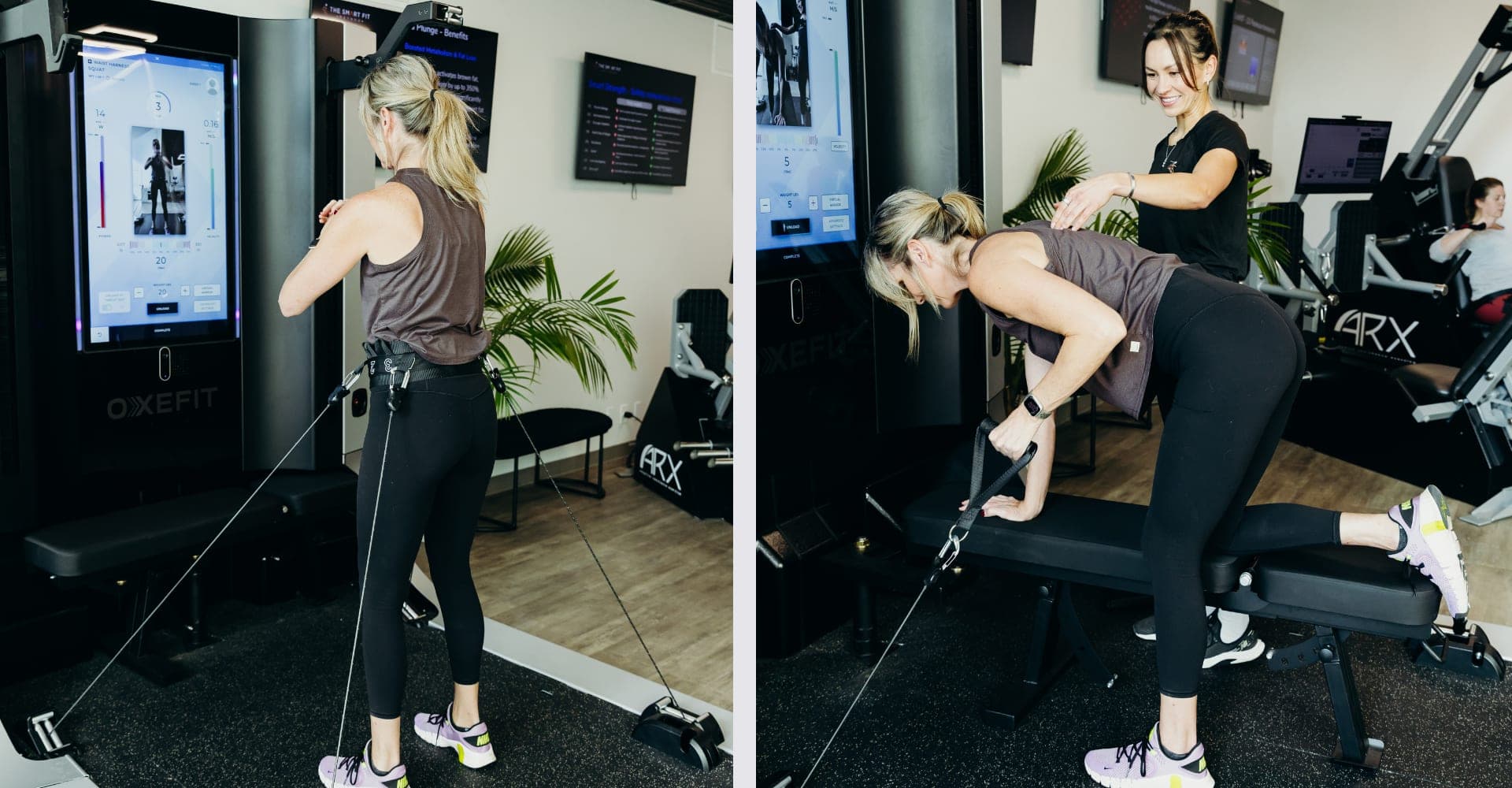
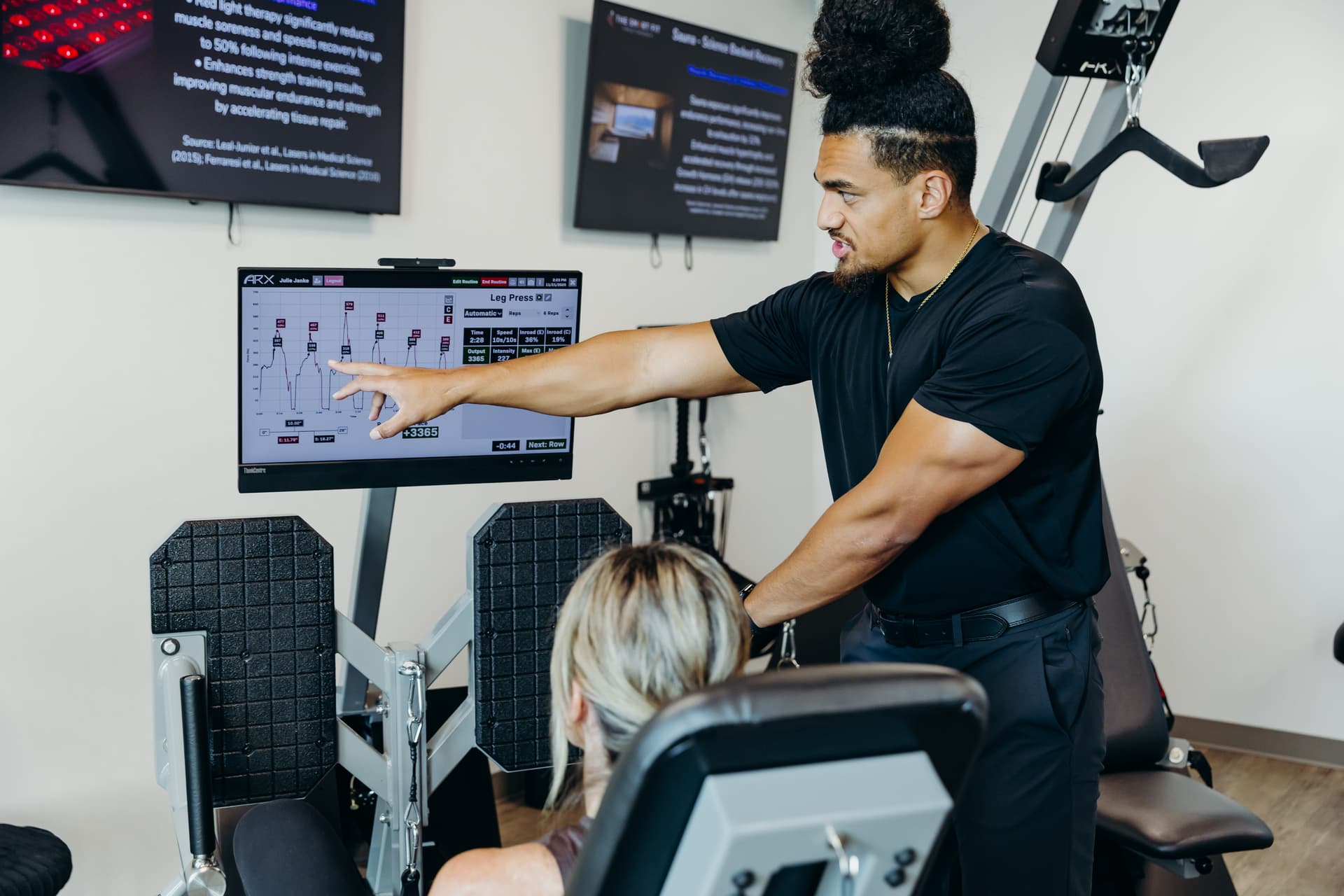
In our studio, we use ARX adaptive resistance technology to solve this. ARX is one of the only commercially available systems that applies a heavier load on the eccentric phase than the concentric.
Unlike a dumbbell that just falls back down, ARX pushes back against you on the way down too, matching your exact effort in real time. The result is a 20-minute session that does more than an hour of traditional training ever could.
This is why our clients tell us they're no longer afraid of injuries, AND they're playing better.
2. The Missing Strength That Makes or Breaks Your Swing
In a rotational sport, your core's primary job isn't to create rotation. It's to resist it.
Every time you swing, force travels from the ground, up through your legs, through your trunk, and into the racket. Your lumbar spine is supposed to remain stable throughout that entire chain. When it can't, the chain breaks. Power leaks. And the spine and shoulder absorb the difference.
Racket sports make this harder than almost any other sport. Unlike golf, you're not just swinging the same direction thousands of times — you're also reaching, lunging, and loading one arm repeatedly. The side-to-side imbalance that builds up over years of play can reach 20-30% between dominant and non-dominant sides. That asymmetry doesn't just cost you power. It's a slow, predictable path to injury.
In studio, we use the OxeFit XP1 to measure force output side-to-side in real time. Most players are genuinely surprised by how significant the gap is. From there we build programming that directly addresses it, closing the imbalance systematically instead of just training around it.
3 Patterns We See in Nearly Every Racket Sport Player, And How To Fix Them
After working with hundreds of racket sport players(pickleball, tennis, padel, squash), the patterns are remarkably consistent.
Most players who walk through our door are fit, active, and genuinely confused about why they keep getting hurt or why their game has plateaued. They've been playing regularly, maybe stretching, maybe hitting the gym. And yet the same 3 physical gaps show up almost every single time. Here's what we find and how we help fix them.
1. The Weak Posterior Chain
If you spend a significant part of your day sitting , and most of us do — your glutes, hamstrings, and calves have likely been quietly underperforming for years. On the court, this shows up as lower back fatigue, a push-off that lacks explosiveness, and a body that's asking the other muscles to overcompensate.
Think of it like a relay race where the anchor runner keeps not showing up. The other runners compensate, work harder than they should, and eventually break down.
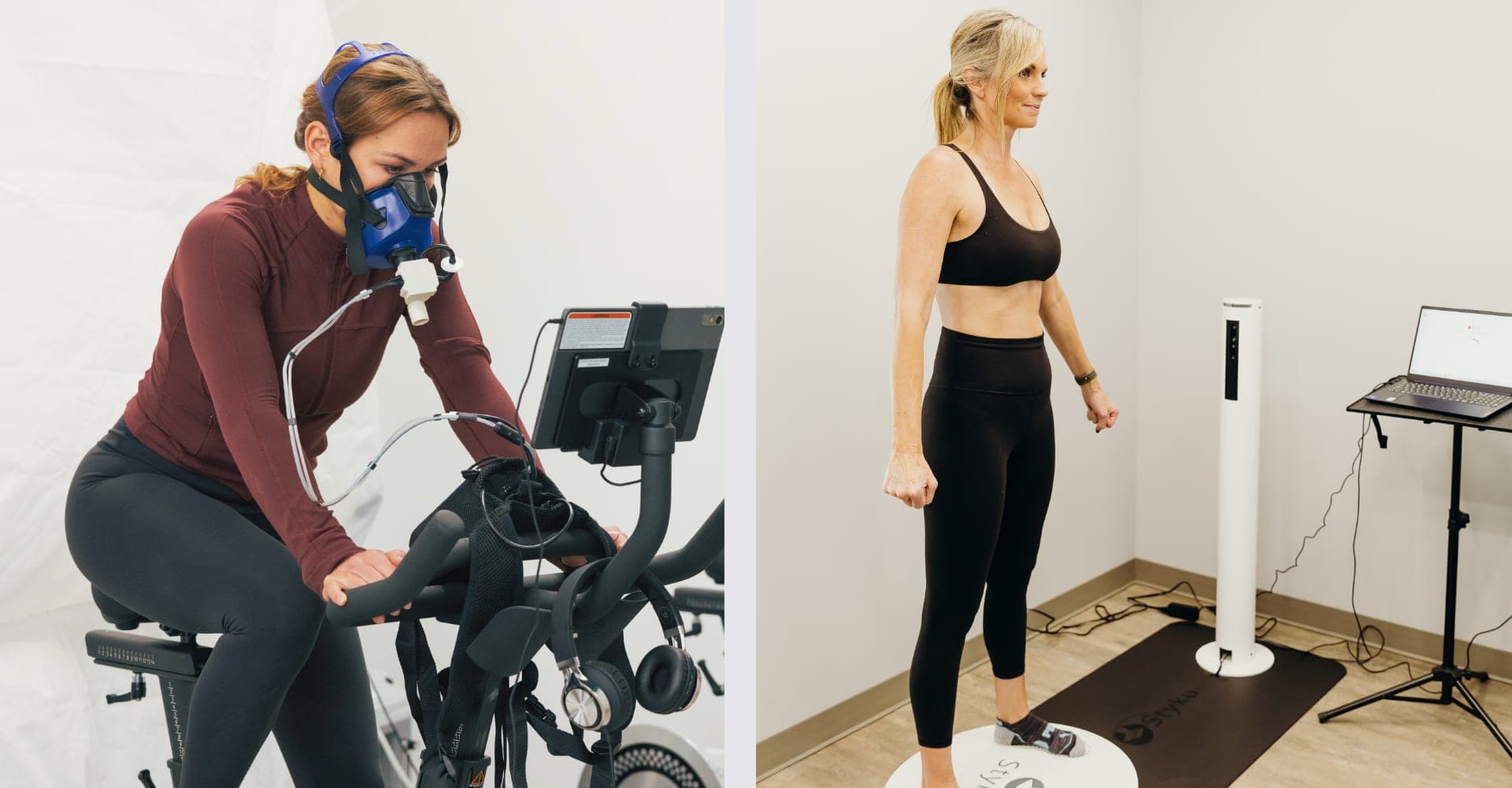
What we do: We assess first by using Styku 3D body scanning and PNOE metabolic testing to map exactly where the compensation is happening. Then we rebuild the posterior chain with loaded eccentric work that restores the right muscles to the right roles. Most clients feel the difference on the court within weeks.
2. The Imbalance Between Your Two Sides
Racket sports are one-sided by nature. You swing, reach, and load the same arm thousands of times. Over months and years, that creates a strength gap between your dominant and non-dominant side that can reach 20-30%. This creates uneven wear on your joints, your spine, and your soft tissue.
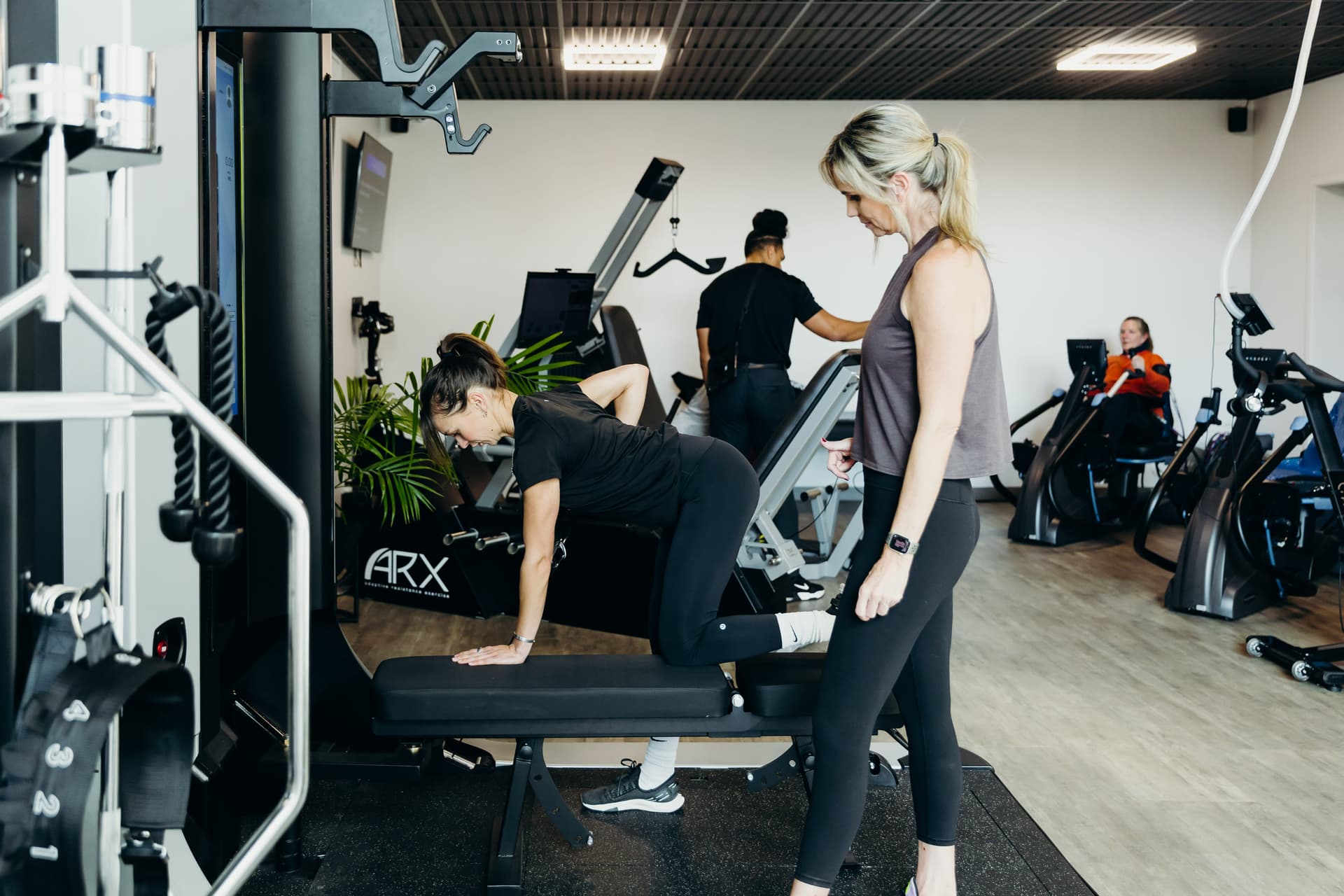
What we do: Using the OxeFit XP1, we measure force output side-to-side in real time. From there we build programming that directly targets the weaker side, closing the imbalance systematically so both sides can share the load the way they're supposed to.
3. The Shoulder That's Been Set Up to Fail
Years of forward-pressing motion(at a desk, in the gym, in life) leaves the back of the shoulder chronically underdeveloped. Add a sport that demands repetitive overhead and rotational loading, and you've got a rotator cuff that's being asked to do far more than it's been prepared for.
Most shoulder injuries in racket sport players aren't accidents. They're the predictable result of an imbalance that's been building for years.
What we do: Targeted posterior shoulder and rotator cuff strengthening, combined with the anti-rotation core work from section two — because a stable trunk takes pressure off the shoulder on every single swing. Fix the foundation, and the shoulder stops being the weakest link in the chain.
You don't have to stop playing your favorite game
The goal isn’t to play it well this year. The goal is to still be playing it at 75, 85.
That requires building the underlying physical capacity the sport demands. This is what a Smart Fit program is engineered to deliver. 20-minute sessions, two to three times a week. Adaptive technology that gives every rep the exact load you need. You don’t have to be one more pickleball or tennis injury statistic, and you don’t have to retire the racket at 65 because your shoulder gave out. The future of your game is about training smarter, so you can keep playing.
That’s exactly what Smart Fit helps you build.
Start your personalized program here
Who We Are, and Why We Want to Train You
At Smart Fit Method, no two programs look the same, because no two bodies are.
Whether you're 35 or 65, recovering from an injury or training to stay ahead of one. You love what you do, in the field, on the courts, on the waves, and in the mountains. You just want to keep doing what you love without your body getting in the way. We have something built specifically for you, and it's never a generic one-size-fits-all.
Every program starts with a full assessment. Every program includes strength, conditioning, recovery, and we adjust as you progress.
This is our method. This is how good training should work.