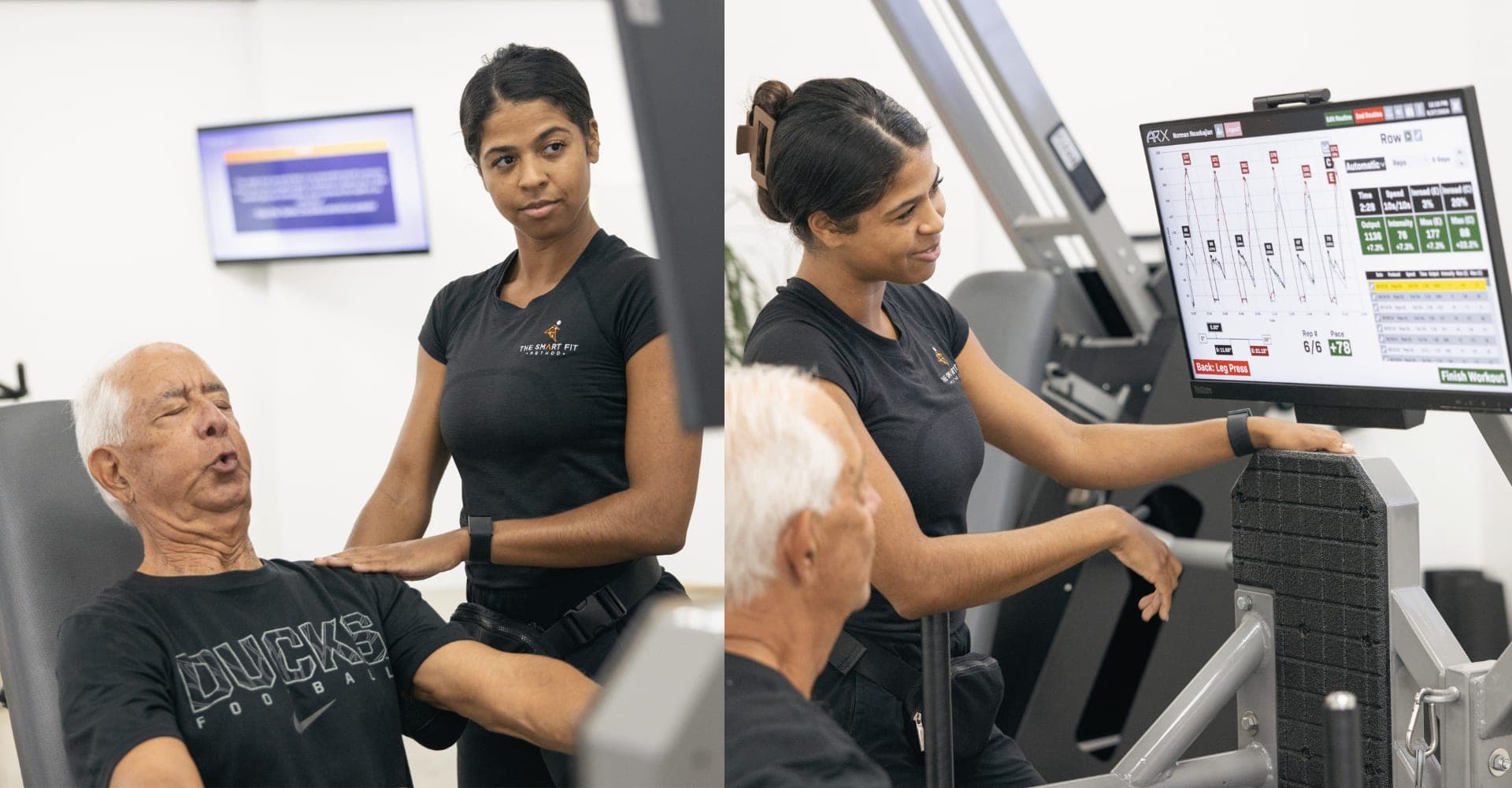
For decades, the prevailing guidance for people over 65 has been cautious: stick to light weights, focus on flexibility and balance, avoid anything that might cause injury. Walk more. Try water aerobics. Maybe some gentle resistance bands. The goal, doctors have long counseled, is maintenance—not building strength.
But a wave of recent research suggests that approach may be precisely wrong. Studies now show that lifting heavy weights—not light ones—is one of the most effective interventions for preventing the muscle loss, bone density decline, and frailty that have long been considered inevitable parts of aging.
The Cost of Being Cautious
Here's what happens when you hit 50: you start losing muscle. Three to eight percent per decade, gone. After 70? That number doubles.
Doctors call it sarcopenia. Most people just call it getting old.
But it's not just about looking weaker or feeling tired. Loss of muscle mass is what leads to falls. And falls lead to fractures. Hip fractures, specifically—the CDC says 95 percent of them happen because someone fell. More than 800,000 seniors end up hospitalized every year because of it.
Ask any emergency room doctor what predicts whether an older patient will fall, and they won't say age. They'll say leg strength.
So we know the problem. We've known it for decades. The solution—lifting heavy things to build muscle back—has been proven in study after study. Yet walk into most doctors' offices at 65 and mention strength training, and you'll get the same cautious speech: be careful, start light, don't overdo it.
That advice isn't just conservative. It might be making things worse.
Yet most seniors avoid the one intervention proven to reverse muscle loss: progressive resistance training with meaningful load. Exercise scientists have known for three decades that high-intensity strength training works in older adults—even seniors well into their 80s and 90s have shown dramatic improvements in muscle strength and walking speed when properly trained.
Seniors can lift heavy. That's not the issue. The issue is how most gyms ask them to do it.
Take barbells. You need perfect balance, perfect form, perfect coordination—all at once, while tired. One wobble and you're hurt.
Dumbbells aren't much better. When your arms start shaking at rep eight, what happens? You twist. You compensate. You recruit muscles that shouldn't be doing the work. That's when things go wrong.
Even the big machines at Planet Fitness have a problem: they use fixed weight. Say you're doing a chest press with 80 pounds. That 80 pounds doesn't change whether you're at the bottom of the movement (where you're weak) or the top (where you're strong). You're either underloading the easy part or overloading the hard part. Neither is ideal.
The Machine That Thinks
There's newer equipment now that works differently. Instead of picking a weight and hoping it's right, the machine adjusts on the fly—every second, throughout every rep.
Here's how: sensors track how much force you're putting out. The machine matches it. Push harder, it pushes back harder. Get to a weak point in the movement? It backs off. Hit a strong point? It ramps up.
It's called adaptive resistance. Sounds fancy, but the idea is simple: the machine meets you where you are, not where some fixed weight stack thinks you should be.
Traditional weight machines use a fixed weight stack—say, 100 pounds—that remains constant throughout the entire movement. But human strength isn't constant. You're stronger at some points in a movement than others, creating weak spots where injury risk spikes.
Adaptive resistance machines use motors and sensors to measure force output hundreds of times per second. When you press against the machine, it pushes back with equal force—but only as much as you can handle at each point in the movement. At the bottom of a chest press, where you're naturally weaker, the machine provides less resistance. At the top, where you're stronger, it provides more.
The result is what exercise scientists call "accommodating resistance"—you work maximally hard throughout the entire range of motion, but you're never overloaded at vulnerable joint angles. No balance required. No setup complexity. The machine remembers your settings and tracks your progress session to session.
The Efficiency Factor
Perhaps the most compelling aspect of this approach is its efficiency. At Smart Fit Method, which uses ARX adaptive resistance technology, a complete strength session covering all major muscle groups takes 20 minutes.
The reason comes down to intensity. Each exercise involves a single set of six to eight repetitions, with each repetition lasting 20 seconds (10 seconds lifting, 10 seconds lowering). That's two minutes per exercise for five exercises, with transitions accounting for the remaining time.
Research on "time under tension"—the total time a muscle spends contracting against resistance—suggests that brief, intense efforts can be as effective as longer, moderate ones. The key is reaching true muscular fatigue safely, which adaptive resistance enables by eliminating the coordination and balance requirements that create risk with traditional equipment.
The Body Composition Blind Spot
Another problem with conventional senior fitness advice is over-reliance on the bathroom scale. Many people gain weight when starting strength training—and their doctors tell them to cut calories. But a 3D body composition scan often tells a different story: muscle gain with simultaneous fat loss.
Why the Scale Lies
Muscle and fat do completely different things in your body. Muscle burns calories all day long, even when you're sitting on the couch. It also helps keep your blood sugar in check. Fat—especially the kind packed around your organs—does the opposite. It cranks up inflammation and messes with your metabolism.
Studies show muscle mass predicts how long you'll live better than your BMI does. But walk into most doctors' offices and what do they check? Your weight. Your BMI. Two numbers that can't tell muscle from fat.
You could gain five pounds of muscle, lose three pounds of fat, and your doctor might tell you to cut back on calories. Because the scale went up.
That's where newer technology comes in. 3D body scanners like Styku show exactly what's happening under your skin—how much is muscle, how much is fat. Metabolic tests (PNOE is one brand) go further: they measure how many calories you burn at rest, how efficiently you use fat for fuel, even your biological age compared to your actual age.
These aren't guess-work numbers. They're measurements. And they tell a completely different story than what your bathroom scale says.
The Recovery Equation
High-intensity training for older adults requires proper recovery. Push too hard, too often, and the body can't repair itself. Research suggests twice-weekly strength training is optimal for most seniors—enough stimulus to build muscle without creating chronic fatigue.
Between sessions, active recovery strategies help. Contrast therapy—alternating between infrared sauna and cold water immersion—appears to reduce inflammation and accelerate recovery by improving circulation and modulating stress hormones. Smart Fit Method incorporates cold therapy protocols (including their Vasper system that combines blood flow restriction, interval training, and cooling) specifically designed to help older adults recover faster between sessions.
The Protein Problem
The final piece is nutrition—specifically, protein. For years, the recommended dietary allowance has been 0.8 grams per kilogram of body weight. But that figure was established to prevent deficiency, not optimize muscle maintenance in aging populations.
Current research suggests seniors need significantly more—closer to 1.0 to 1.2 grams per kilogram. The reason is "anabolic resistance," which means our msucles becoem less reponsive to the amino acides protein as we age. More protein per meal is needed to trigger muscle protein synthesis.
Studies show that seniors consuming the standard RDA can lose muscle mass even while strength training, while those consuming higher amounts gain muscle. Protein is the building material—without adequate supply, the body cannot build new muscle tissue regardless of training stimulus.
What This Means
The gap between what research shows and what most doctors recommend remains wide. Medical training still emphasizes caution over capacity. Many physicians trained decades ago have never updated their guidance based on new evidence.
Insurance coverage compounds the problem. Medicare pays for cardiac rehabilitation and physical therapy but not preventive strength training—despite evidence that preventing muscle loss is far more cost-effective than treating its consequences.
For most seniors, access to evidence-based strength training requires either private pay at specialized facilities or the knowledge and confidence to navigate traditional gyms safely. The alternative—the slow decline that most people still accept as inevitable—is neither inevitable nor acceptable.
Strength training with progressive overload—real load, not token resistance—appears to be one of the few interventions that can truly slow biological aging. The challenge is translating research into practice in a healthcare system built around treatment, not prevention.
Ready to learn more? Smart Fit Method offers a free Smart LongevityCheck: 3D body scan + metabolic test + personalized training plan to establish your baseline and create a safe progression strategy.